
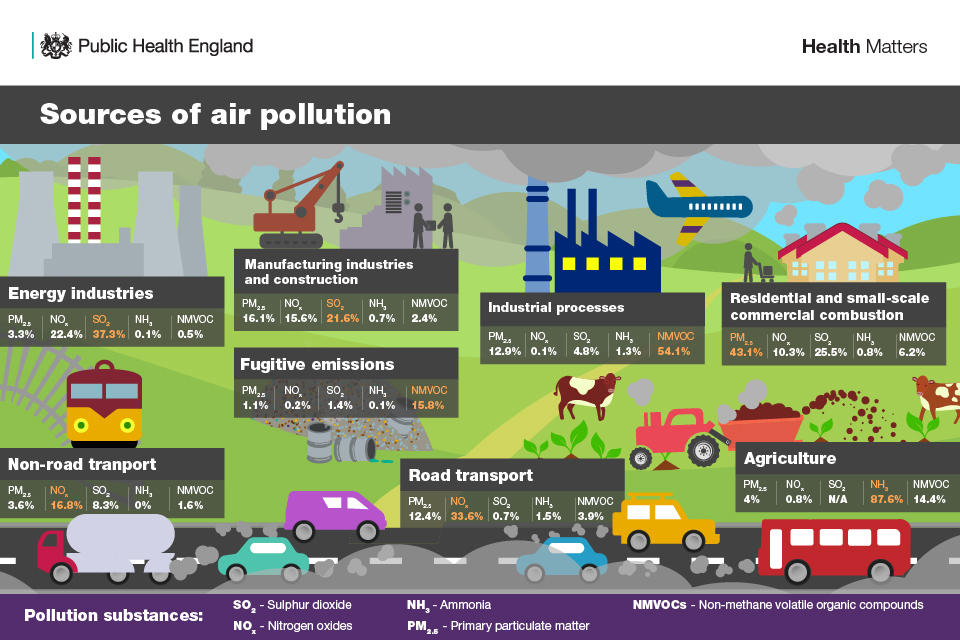
Image credit: Public Health England
Air pollution is a complex blend of gases and particulate matter (PM) that originates from both natural processes and human activities. Among the most significant contributors to urban air pollution are particulate matter (PM) and nitrogen dioxide (NO₂). Notably, there is currently no scientific consensus on a threshold level of exposure to these pollutants that is completely safe. This suggests that even reducing concentrations below existing air quality standards could deliver further health benefits.
Particulate matter refers to a varied mixture of solid and liquid particles suspended in the air. These particles differ in size, shape, and chemical composition. PM can be directly released into the air (primary PM) or formed through atmospheric chemical reactions (secondary PM). Its composition is influenced by factors such as geography, emission sources, and weather conditions.
Human-made sources include fuel combustion from vehicles, industrial operations, and domestic heating, as well as physical processes like tyre and brake wear. Natural sources encompass wind-blown dust, sea spray, and vegetation fires.
The smaller the particle, the deeper it can penetrate into the lungs, making fine and ultrafine particles particularly hazardous. Particles larger than 10 µm tend to be trapped in the nose or throat, while PM₂.₅ and smaller particles can reach deep into the lungs and even enter the bloodstream.
Long-term exposure to PM is linked to increased rates of cardiovascular and respiratory diseases and has been associated with higher mortality. The International Agency for Research on Cancer (IARC) classifies outdoor air pollution, especially PM, as carcinogenic to humans (Group 1), due to its link to lung cancer. Emerging research also suggests that ultrafine particles might pass into the bloodstream, further contributing to health risks.
NO₂ is a gas released during the combustion of fuel, often alongside nitric oxide (NO); together, they are known as nitrogen oxides (NOₓ). In areas exceeding NO₂ limits, the Department for Environment, Food & Rural Affairs (Defra) estimates that 80% of NOₓ emissions come from transport—primarily from diesel cars and vans. Other contributors include power generation, industry, and home heating systems.
The Committee on the Medical Effects of Air Pollutants (COMEAP) has shown that short-term exposure to NO₂ at high levels causes respiratory irritation, leading to coughing, mucus production, and shortness of breath. Studies link NO₂ exposure to reduced lung growth in children, increased respiratory infections, and compromised lung function in adults. While it's uncertain whether these effects stem directly from NO₂ or from other pollutants emitted alongside it, a strong association with adverse health outcomes has been documented.
Produced by burning sulphur-rich fuels like coal, SO₂ is a sharp-smelling gas that can form sulphate particles in the air. While SO₂ levels in the UK have declined significantly over the past five decades due to reduced coal use, remaining sources include industrial facilities and domestic stoves. Exposure causes irritation to the nose, throat, and airways.
Emitted from both natural and man-made sources, NH₃ contributes to environmental damage by causing nitrogen enrichment (eutrophication) and acidification of ecosystems. It also plays a role in forming PM₂.₅ through reactions with acidic gases like sulphuric and nitric acids. Agriculture is a key contributor to NH₃ emissions, and it has been linked to spikes in PM pollution in the UK.
At ground level, ozone is formed through photochemical reactions involving nitrogen oxides and volatile organic compounds (VOCs) in sunlight. Though not directly emitted, ground-level ozone is harmful to human health, particularly affecting the respiratory system. Some studies have also suggested potential impacts on the cardiovascular system.
CO is a colourless, odourless gas generated by incomplete combustion of fuels like wood, coal, and gas. It can be emitted from household appliances, vehicles, and cigarette smoke. High-level indoor exposure can be fatal, while lower levels may cause flu-like symptoms or mimic food poisoning.
These are a diverse group of chemicals emitted from both natural sources and human activities such as industrial processes and agriculture. NMVOC emissions in the UK have declined by 68% between 1970 and 2016, with the sharpest drops occurring in the 1990s due to decreased coal use. Indoors, they are released from household products and can contribute to air pollution. Outdoors, NMVOCs react with NOₓ and sunlight to form ozone, which is harmful to health and the environment.